
The dollar gained against other currencies overseas.

The rupee on Monday slipped by 5 paise to close at 63.57 per dollar on fresh demand for the American currency from banks.
The rupee had strengthened by 19 paise on Monday.
Robust foreign capital inflows into upbeat domestic equity markets on the back of better macro fundamentals helped the rupee to gain

'For someone who wants to invest for the future or his family, diversification is necessary.' 'Diversify across asset classes -- equities, gold, real estate, fixed income, commodities, and even cryptocurrency.'

The 30-share S&P BSE Sensex ended up 130 points at 25,400 and the Nifty50 rose 46 points to close at 7,759.
The BSE Mid-cap index gained 1.1% while the Small-cap index surged 1.3%, outperforming the benchmark indices

The US dollar has risen about 15 per cent since mid-2015.

The S&P and Dow dipped the most in a day since September 28.

They expressed concern on taxation issues, the high fiscal and current account deficits, and sought removal of capital gains tax.

Sensex to end this year at 27,500 and reach 29,000 by mid 2016.

Market experts poohpooh fears of capital flight from India.

The S&P BSE Midcap and the S&P BSE Smallcap indices under-performed to lose 0.8% and 1.6%
RBI is committed to bringing down retail inflation to eight per cent by January 2015 and six per cent by January 2016.

We have not suffered such huge price shocks across so many basic commodities, at the same time, in decades. Has the inflationary impact of all this been factored into stock prices as yet, asks Debashis Basu.

The broader markets ended negatively with mid-caps and small-caps shedding 0.5 per cent on the BSE.

Given the developments, analysts do not foresee a quick recovery.

Markets now expect the Fed to normalise rates gradually.

The central bank maintained its bias towards a rate hike.

This was the near-unanimous replies of 10 market participants.

India's numbers have shown a reasonable amount of improvement.

US job growth increased at a fairly brisk clip in October and the unemployment rate fell to a fresh six-year low of 5.8 per cent, underscoring the economy's resilience in the face of slowing global demand.

Sweden has the world's highest negative rate.

An expected withdrawal of FIIs from the market likely to weaken the rupee against the dollar.
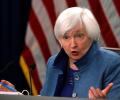
Hawkish guidance by the US Fed raises concerns it could tie the hands of RBI from trimming rates.
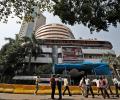
Participants are keeping an eye on the Winter Session of Parliament, which started today, and US fiscal policies to be followed by President-elect Donald Trump

Many in the US establishment must hope that the crisis would put the brakes on China's growing military might. Well, it ain't gonna happen, says T T Ram Mohan, who was appointed a member of the prime minister's economic advisory council on Wednesday, October 28, 2021.

Three major central banks have hit the zero limit, the Fed, the European Central Bank and the Bank of Japan.

ICICI Bank and SBI were among the top Sensex gainers along with FMCG majors ITC and HUL.

Given Indian corporates's high indebtedness, new credit will be used for servicing loans rather than building factories. This is setting us up for more companies on life support and more zombie banks, warns Rahul Jacob.

Summers dogged by controversies over past views

The Bank Nifty is high beta anyhow and it could move the broader market.

Gold is often considered a 'hedge' against an economic uncertainty.

Dealers expect prices to fall further, owing to an impending rate hike in the US

Some investors had speculated that the US central bank might put its plans on hold given the jitters overseas.

The 30-share Sensex ended higher by 30 points.

Devangshu Datta predicts the good, the bad and the ugly of currency trends for the coming year.
.jpg)
India's share of 2015 emerging market allocations will be driven by FII perceptions on likely growth and reform.

The fuzziness of Trump's economic blueprint remains the biggest risk.

Experts advise investors to buy at lower levels in the next few months and sell at the higher end of their range in the second half, reports Rajesh Bhayani.
